
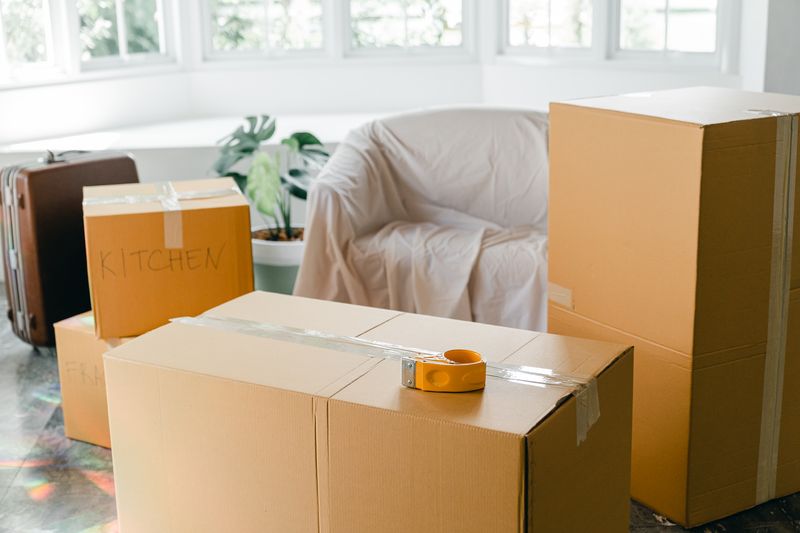
A well-filled box survives the journey; a badly filled one opens at the bottom, lets things knock into each other or caves in under the weight of the box on top. Our guide on how to pack for a move (in Spanish) gives you the overall plan: materials, order and room by room. Here we zoom in: one box, from the bottom to the label.
The quick answerSeal the bottom with H-taping and add a bed of scrunched-up paper. Heavy things at the bottom and in small boxes; light and fragile things on top. Plates on their edge, paper inside glasses and no gaps: if something rattles when you give it a shake, it needs more padding. The top should close flat, you should be able to lift it without effort, and label it on two sides with the room, "fragile" and "this way up".
Before you fill it: choose and build the box properly
- Dry and undamaged. No crushed corners or damp: a box that's been wet once loses strength. Fruit boxes from the supermarket won't take weight.
- The bottom, H-taped: one strip along the middle seam and one along each edge, from side to side. If it's going to be heavy, give it a second layer.
- Don't interlock the flaps by tucking one under the other to save tape: that's exactly how a box opens at the bottom as soon as it's heavy.
- A bed of scrunched-up paper at the bottom, a few fingers deep. It's the cushion for everything that goes on top.
How much should a box weigh?
There's no magic number, but there is an official reference. The INSST (Spain's National Institute for Safety and Health at Work) technical guide on manual handling of loads takes as the maximum weight, in ideal conditions, 25 kg for men aged 20 to 45 and 20 kg for women of the same age, and less for everyone else. It also warns that when conditions aren't ideal, that maximum goes down.
There's nothing ideal about a move: there are stairs, narrow doorways and boxes you pick up from the floor. That's why our advice is more cautious than any figure: every box should be liftable without effort by the weakest of the people carrying, held close to the body with a straight back. If in doubt, it's too heavy: take something out and move it to another box.
The same guide gives two tips that work at home too: the load shouldn't block your view, and ideally it shouldn't be wider than your shoulders. That's why books and crockery go in small boxes.
What goes in each box
| What goes inside | Box |
|---|---|
| Books, plates, tins, bottles, toolsThings that are heavy for their size | Small |
| Pots, pans, glasses, food containers, shoes, small appliancesMedium weight | Medium |
| Folded clothes, towels, cushions, duvets, soft toysBulky but light | Large |
If you only have medium boxes, fill the book boxes halfway and top them up with something that's light and won't break, like clothes or towels.
How to fill it, from the bottom up
- At the bottom, the heaviest and sturdiest things: books, pots, anything that won't break.
- In the middle, the medium-weight things, packed in tightly.
- On top, the light and fragile things, so nothing falls on them.
- Every gap, filled with scrunched-up paper, tea towels, socks or towels: nothing should be able to move.
- No mixing: heavy with heavy, fragile with fragile, and one room per box.
The two tests before you close it
- The shake test: with the flaps held shut by hand, move the box gently. If something rattles or slides, it needs more padding.
- The lid test: it has to close flat. If it bulges, there's too much in it and the box on top won't sit properly; if it sinks, it needs more padding and it'll get crushed by the weight of the one above.
Item by item
Plates
Wrap them one by one in paper and stand them on their edge, like records on a shelf, never stacked flat: on their edge they take weight and knocks much better. Scrunched-up paper at the bottom, between each row and on top.
Glasses and wine glasses
Put a ball of paper inside each glass before you wrap it: that way the glass doesn't give inwards if it gets knocked. Wrap it completely and stand it upright, never on its side, in the top layer with nothing heavy above it. For wine glasses, extra paper around the stem, which is where they break. If you can get boxes with cardboard dividers, like bottle boxes, even better.
Pots, pans and lids
One inside the other, with paper in between so they don't scratch. The lids, wrapped separately and on their edge, down one side of the box.
Bottles and liquids
Open the cap, put a piece of cling film over the top and close it again: that way it won't drip. Always upright, together and inside a sealed bag, just in case.
Lamps, frames and small appliances
The bulb comes out; the lampshade goes in its own box with paper. Frames, wrapped and on their edge. Appliances in their original box if you've kept it; if not, wrapped in a towel, with the cables in a bag labelled with the appliance's name.
Close it and label it
- H-taping on top too. If the box is heavy, one more strip all the way round.
- Label it on two opposite sides, not just the top: when boxes are stacked, you can't see the top.
- The room it's going to, not the one it came from, and underneath, what's inside in two or three words.
- If there's anything fragile, "FRAGILE" in big letters and an arrow pointing up on each side.
- Number the boxes and take a photo of what's inside before you close them: with the number and the photo on your phone, you'll find anything without opening ten boxes.
- One colour per room, with tape or stickers, helps whoever's unloading: you can see from a distance where each box goes.
When we do the loading, boxes marked as fragile go on top and never with weight on them, so what you write on the label is what we follow.
What doesn't go in a box
- Anything that can catch fire: aerosols, solvents, petrol, gas canisters.
- Open cleaning products and bleach: if they leak, they ruin everything around them.
- Food that goes off and whatever's in the freezer.
- Plants: they travel separately, upright and with nothing on top.
- Whatever travels with you: documents, money, jewellery, medication, keys, your laptop, hard drives and chargers. They go in your backpack or in the first-night box.
If you'd rather we did it
On our moves, packing up to 15 boxes for you is free; 16 to 20 boxes is €179, 21 to 40 is €310, and 41 to 50 is €499. If you need boxes, new ones cost €3.08 each, with a minimum of 5 and delivery included.
| What | Price |
|---|---|
| Studio flat move2 movers, up to 10 m³ | €349.00 |
| 12 new boxes12 × €3.08 | €36.96 |
| Packing the 12 boxesFree up to 15 boxes | €0.00 |
| Total | €385.96 |
See how we work on moving in Madrid and get your price with the boxes you need. If you're not sure how many that is, start with how many boxes you need for a move (in Spanish). And if some don't fit in your new home, we'll store them for you with our storage with home pick-up.
Frequently asked questions
What's the maximum a moving box should weigh?
The INSST technical guide takes 25 kg as the maximum, in ideal conditions, for men aged 20 to 45 and 20 kg for women of the same age, and less when conditions aren't ideal. For a move, stay well below that: the weakest person carrying should be able to lift it without effort.
Do plates go upright or flat?
On their edge, like records on a shelf, each one wrapped separately, with scrunched-up paper at the bottom, between rows and on top. Stacked flat, they break more easily.
Where do you write the label on a moving box?
On two opposite sides, not just the top, because when boxes are stacked you can't see the top. Write the room it's going to, what's inside and, if needed, "fragile" and an arrow pointing up.
Sources
- INSST (Spain's National Institute for Safety and Health at Work), "Guía técnica para la evaluación y prevención de los riesgos relativos a la manipulación manual de cargas" (technical guide on the assessment and prevention of risks from manual handling of loads, in Spanish), September 2024 edition: reference maximum weights (table 2), visibility and width of the load. Accessed on 28 October 2026.